

Tone Woods Commonly Used in Guitars
When searching for just the right tone and response in a guitar, knowing what differing tone woods offer is a key step. Combining that knowledge with a good understanding of your own playing technique and most common musical style can help you find the perfect guitar.
Tone woods commonly used for guitar backs and sides include Brazilian rosewood, Indian rosewood, mahogany, koa, walnut, and maple. Each has its own tonal characteristics. Here’s a brief description of each:
Brazilian rosewood: Now extremely rare and equally expensive due to its endangered status, many guitarists think of this as the “holy grail” of tone woods. Its color ranges from dark brown to purples with dark streaks of near black. A highly resonant wood, Brazilian rosewood offers a deep bass response. Usually this wood is best suited to dreadnaughts or larger bodied guitars.
Indian rosewood: Of the same family of woods as Brazilian rosewood, this species is much more common and therefore comparatively affordable. Many luthiers consider Indian to be more stable and consistent than other rosewood species. Coloration of Indian rosewood is slightly different than its Brazilian counterpart and runs more to red than purple, but still includes the familiar dark brown and near black streaks. Like Brazilian, Indian rosewood produces a satisfying and powerful bass response. Due to its availability and costs, Indian rosewood is most commonly used in high quality instruments.
 |
| Walnut back and sides are a feature of this Taylor guitar. |
Mahogany: Mahogany is a lighter weight wood than either of the two rosewood species, but delivers a surprisingly loud volume with an emphasis on bright, clear treble notes. This feature alone makes it a favorite choice among flat pickers who need to cut through an ensemble to be heard. Ranging from yellowish brown to reddish brown in color, mahogany is a popular choice among many of our customers.
Walnut: With striking colors ranging from browns to whites and with shades of purple, red, and black, walnut produces an exceptionally warm tone. This hard and stable wood delivers a tone reminiscent of rosewood with deep bass, resonant mids and highs, and excellent projection. Not as common as rosewood or mahogany guitars, walnut offers another interesting voice.
Koa: This Hawaiian wood offers slightly less bass and treble response when compared to rosewood or mahogany. What koa delivers is well-balanced tone. Part of koa’s attraction to luthiers and guitarists alike is its beauty. Koa is golden brown with dark streaks and an almost glowing sheen. It will also occasionally develop a curly or flamed figure as well.
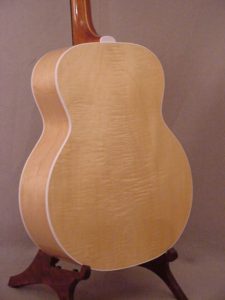 |
| Maple back and sides on a Guild Jumbo 12-string. |
Maple: Maple has a bright and somewhat jangly tone with a good balance of highs, mids, and lows. It commonly has better than average projection due to its hardness. Maple also has a relatively quick note “decay” which makes it a great choice for 12-strings. Its understated tan coloration is enhanced with a wide variation of grain patterns including fiddleback, quilted, or highly flamed. While not a common choice, maple is among the most beautiful of tone woods.
Woods used for guitar tops must exhibit a unique combination of strength and resonance. Like woods for sides and backs, each top has its own characteristics.
 |
| The Bourgeois D features a spruce top. |
Spruce: Spruce is popular among luthiers for its straight, uniform grain and strength. Guitarists love spruce for its vibrant tone. There are several species that exhibit roughly the same characteristics and are used almost interchangeably. Sitka spruce is the most commonly used.Englemann Spruce: Much like Brazilian rosewood is prized for guitar backs and sides, Englemann spruce is considered among the highest quality wood for guitar tops. Its appearance is very similar to other spruces but has a slightly whiter hue. It is extremely light yet produces a slightly louder and more open tone than other species of spruce. Englemann is only found in high mountain elevations in the American Rockies and Pacific Cascade range. Its availability is limited now and is expected to be even less in the future.
Western Red Cedar: Western red cedar has long been associated with classical guitar tops, but has gained popularity in recent years with steel string enthusiasts. Cedar commonly produces a warm, mellow tone with an even balance across the highs, mids, and lows. Cedar’s light brown color also shows beautifully in junction with darker woods to make a visually striking guitar.
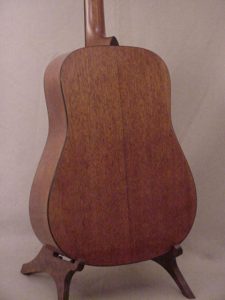 |
| A Martin D-17 with a mahogany top. |
Mahogany: Mahogany is occasionally used for guitar tops as well as backs and sides. Mahogany has less projection than spruce, but has a mellow response with an emphasis on the mids.
Koa: Koa top guitars tend to be smaller-bodied due to nature of its tonal response. Koa has less volume than spruce, yet produces a bright treble tone. One of the most popular features of koa top guitars is the sheer beauty of the wood. For that reason alone, many guitar enthusiasts seek out a koa-topped instrument to add to their collection.
For an even more in-depth discussion of tonewoods, visit Bourgeois Guitars’ website for their article about their tonewoods.

do you know what specific tonewood varieties grow native in the Ozarks? specifically SW MO? Thanks.